Old Dogs …

My beautiful red girl, Ali, turned eleven earlier this month.  While that’s not “old” considering some Apsos can live well into their late teens or even into their 20s, she has entered what I term the “worry years.”  There’s this little nagging thought at the back of my brain which reminds me her days are numbered.  All that remains is what that number actually is … a mystery at this point.  And so, from time to time, I worry.  How long?  How will her health hold out?  Is she developing arthritis or a little doggy dementia?  Is there something I can do to mitigate the aging process besides what I’m already doing?  Each day becomes more precious as I notice the subtle signs of aging. 

Ali ... with that Mona Lhasa smile

Ali … with that “Mona Lhasa” smile

Old Dogs …

 They can be eccentric, slow afoot, even grouchy. But dogs live out their final days, says The Washington Post’s Gene Weingarten, with a humility and grace we all could learn from.

Not long before his death, Harry and I headed out for a walk that proved eventful. He was nearly 13, old for a big dog. Walks were no longer the slap-happy Iditarods of his youth, frenzies of purposeless pulling in which we would cast madly off in all directions, fighting for command. Nor were they the exuberant archaeological expeditions of his middle years, when every other tree or hydrant or blade of grass held tantalizing secrets about his neighbors. In his old age, Harry had transformed his walk into a simple process of elimination – a dutiful, utilitarian, head-down trudge. When finished, he would shuffle home to his ratty old bed, which graced our living room because Harry could no longer ascend the stairs. On these walks, Harry seemed oblivious to his surroundings, absorbed in the arduous responsibility of placing foot before foot before foot before foot. But this time, on the edge of a small urban park, he stopped to watch something. A man was throwing a Frisbee to his dog. The dog, about Harry’s size, was tracking the flight expertly, as Harry had once done, anticipating hooks and slices by watching the pitch and roll and yaw of the disc, as Harry had done, then catching it with a joyful, punctuating leap, as Harry had once done, too.

Harry sat. For ten minutes, he watched the fling and catch, fling and catch, his face contented, his eyes alight, his tail a-twitch. Our walk home was almost … jaunty.

Some years ago, The Washington Post invited readers to come up with a midlife list of goals for an underachiever. The first-runner-up prize went to: “Win the admiration of my dog.”

It’s no big deal to love a dog; they make it so easy for you. They find you brilliant, even if you are a witling. You fascinate them, even if you are as dull as a butter knife. They are fond of you, even if you are a genocidal maniac. Hitler loved his dogs, and they loved him.

Puppies are incomparably cute and incomparably entertaining, and, best of all, they smell exactly like puppies. At middle age, a dog has settled into the knuckle-headed matrix of behavior we find so appealing – his unquestioning loyalty, his irrepressible willingness to please, his infectious happiness. But it is not until a dog gets old that his most important virtues ripen and coalesce. Old dogs can be cloudy-eyed and grouchy, gray of muzzle, graceless of gait, odd of habit, hard of hearing, pimply, wheezy, lazy, and lumpy. But to anyone who has ever known an old dog, these flaws are of little consequence. Old dogs are vulnerable. They show exorbitant gratitude and limitless trust. They are without artifice. They are funny in new and unexpected ways. But, above all, they seem at peace.

Kafka wrote that the meaning of life is that it ends. He meant that our lives are shaped and shaded by the existential terror of knowing that all is finite. This anxiety informs poetry, literature, the monuments we build, the wars we wage-all of it. Kafka was talking, of course, about people. Among animals, only humans are said to be self – aware enough to comprehend the passage of time and the grim truth of mortality. How, then, to explain old Harry at the edge of that park, gray and lame, just days from the end, experiencing what can only be called wistfulness and nostalgia? I have lived with eight dogs, watched six of them grow old and infirm with grace and dignity, and die with what seemed to be acceptance. I have seen old dogs grieve at the loss of their friends. I have come to believe that as they age, dogs comprehend the passage of time, and, if not the inevitability of death, certainly the relentlessness of the onset of their frailties. They understand that what’s gone is gone.

What dogs do not have is an abstract sense of fear, or a feeling of injustice or entitlement. They do not see themselves, as we do, as tragic heroes, battling ceaselessly against the merciless onslaught of time. Unlike us, old dogs lack the audacity to mythologize their lives. You’ve got to love them for that.

The product of a Kansas puppy mill, Harry was sold to us as a yellow Labrador retriever. I suppose it was technically true, but only in the sense that TicTacs are technically “food.” Harry’s lineage was suspect. He wasn’t the square-headed, elegant type of Labrador you can envision in the wilds of Canada hunting for ducks. He was the shape of a baked potato, with the color and luster of an interoffice envelope. You could envision him in the wilds of suburban Toledo, hunting for nuggets of dried food in a carpet.

His full name was Harry S Truman, and once he’d reached middle age, he had indeed developed the unassuming soul of a haberdasher. We sometimes called him Tru, which fit his loyalty but was in other ways a misnomer: Harry was a bit of an eccentric, a few bubbles off plumb. Though he had never experienced an electrical shock, whenever he encountered a wire on the floor-say, a power cord leading from a laptop to a wall socket-Harry would stop and refuse to proceed. To him, this barrier was as impassable as the Himalayas. He’d stand there, waiting for someone to move it. Also, he was afraid of wind.

While Harry lacked the wiliness and cunning of some dogs, I did watch one day as he figured out a basic principle of physics. He was playing with a water bottle in our backyard-it was one of those five-gallon cylindrical plastic jugs from the top of a water cooler. At one point, it rolled down a hill, which surprised and delighted him. He retrieved it, brought it back up and tried to make it go down again. It wouldn’t. I watched him nudge it around until he discovered that for the bottle to roll, its long axis had to be perpendicular to the slope of the hill. You could see the understanding dawn on his face; it was Archimedes in his bath, Helen Keller at the water spigot.

That was probably the intellectual achievement of Harry’s life, tarnished only slightly by the fact that he spent the next two hours insipidly entranced, rolling the bottle down and hauling it back up. He did not come inside until it grew too dark for him to see.

I believe I know exactly when Harry became an old dog. He was about nine years old. It happened at 10:15 on the evening of June 21, 2001, the day my family moved from the suburbs to the city. The move took longer than we’d anticipated. Inexcusably, Harry had been left alone in the vacated house-eerie, echoing, empty of furniture and of all belongings except Harry and his bed – for eight hours. When I arrived to pick him up, he was beyond frantic.

He met me at the door and embraced me around the waist in a way that is not immediately reconcilable with the musculature and skeleton of a dog’s front legs. I could not extricate myself from his grasp. We walked out of that house like a slow-dancing couple, and Harry did not let go until I opened the car door.

He wasn’t barking at me in reprimand, as he once might have done. He hadn’t fouled the house in spite. That night, Harry was simply scared and vulnerable, impossibly sweet and needy and grateful. He had lost something of himself, but he had gained something more touching and more valuable. He had entered old age.

In the year after our move, Harry began to age visibly, and he did it the way most dogs do. First his muzzle began to whiten, and then the white slowly crept backward to swallow his entire head. As he became more sedentary, he thickened a bit, too.

On walks, he would no longer bother to scout and circle for a place to relieve himself. He would simply do it in mid-plod, like a horse, leaving the difficult logistics of drive-by cleanup to me. Sometimes, while crossing a busy street, with cars whizzing by, he would plop down to scratch his ear. Sometimes, he would forget where he was and why he was there. To the amusement of passersbys, I would have to hunker down beside him and say, “Harry, we’re on a walk, and we’re going home now. Home is this way, okay?” On these dutiful walks, Harry ignored almost everything he passed. The most notable exception was an old, barrel-chested female pit bull named Honey, whom he loved. This was surprising, both because other dogs had long ago ceased to interest Harry at all, and because even back when they did, Harry’s tastes were for the guys.

Still, when we met Honey on walks, Harry perked up. Honey was younger by five years and heartier by a mile, but she liked Harry and slowed her gait when he was around. They waddled together for blocks, eyes forward, hardly interacting but content in each other’s company. I will forever be grateful to Honey for sweetening Harry’s last days.

Some people who seem unmoved by the deaths of tens of thousands through war or natural disaster will nonetheless grieve inconsolably over the loss of the family dog. People who find this behavior distasteful are often the ones without pets. It is hard to understand, in the abstract, the degree to which a companion animal, particularly after a long life, becomes a part of you. I believe I’ve figured out what this is all about. It is not as noble as I’d like it to be, but it is not anything of which to be ashamed, either.

In our dogs, we see ourselves. Dogs exhibit almost all of our emotions; if you think a dog cannot register envy or pity or pride or melancholia, you have never lived with one for any length of time. What dogs lack is our ability to dissimulate. They wear their emotions nakedly, and so, in watching them, we see ourselves as we would be if we were stripped of posture and pretense. Their innocence is enormously appealing. When we watch a dog progress from puppyhood to old age, we are watching our own lives in microcosm. Our dogs become old, frail, crotchety, and vulnerable, just as Grandma did, just as we surely will, come the day. When we grieve for them, we grieve for ourselves.

From the book Old Dogs, text by Gene Weingarten and Michael S. Williamson, based on a longer excerpt that originally appeared in The Washington Post.

© 2008 by Gene Weingarten and Michael S. Williamson.    Reprinted by permission of Simon & Schuster Inc.
The Tibetan Dog Reincarnation …

As appearing in the November 18, 2008 The Norman Transcript … 

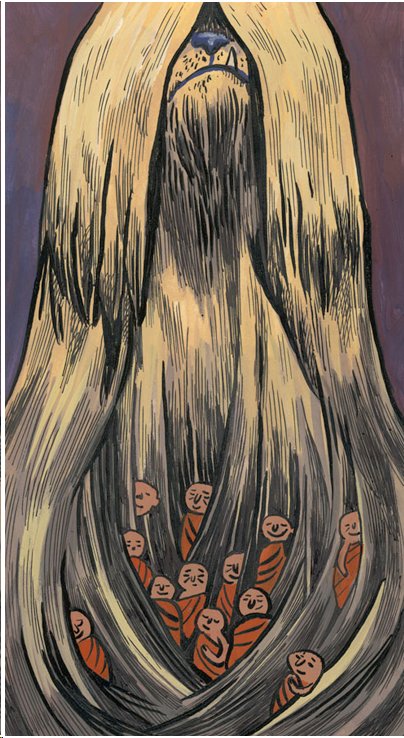
Bedtime for Buddhas
Bedtime for Buddhas – L. Park

The Tibetan Dog Reincarnation

In Tibetan lore each Lama (like the Dali) has a Temple dog. When a Lama dies it is believed that he is reincarnated as another Temple dog. Thus he would serve two lifetimes of strict adherence to ritual worship, chanting, meditating, sacrifice, no tv, no dessert and no squeaky bone toy.

Sid saw Buster abandoned on the highway. At first she thought he was a porcupine. Covered with burrs, leaves and sticks, his hair matted in dreadlocks, he was a pitiful sight, but… he was a dog.

She pulled over, opened the door and picked up Buster. It was a hot Saturday afternoon in southern Pennsylvania. Sid drove back to the State Police Barracks and asked the location of the Humane Society.

“Don’t have one in Fulton County,” said the policeman.

“A dog catcher?” she asked.

“I saw his wife at the grocery store. He’s gone for the weekend. Be back Tuesday,” replied the officer cheerfully.

“Is there someplace I could ask about a lost dog report? Like a radio station or newspaper?”

“Nope. But you could take him to the pound in Adams County. Just don’t tell them you’re from Fulton County or they won’t take him.”

He gave Sid a pair of plastic handcuffs so she could take Buster out to pee. Bent at the waist, grasping the stiff handcuff leash she looked like a beachcomber dusting the lawn with a giant hairball.

At a strip mall in Chambersburg she bought a leash, harness, crate and dog food. This was how she arrived at her destination, the house of a friend who promptly said, “You can’t leave it here.” She put him in his crate, from which he escaped three times, the last of which was from the crate; duct-taped, bungee-corded, locked and put in the garage… in 15 minutes. Houdini couldn’t have done it better. They all agreed that Buster had adopted Sid.

Later at the dog wash, the attendant recognized the flea-bitten, moth ridden, canine flannel rag mop as a Lhasa Apso, a revered Tibetan Temple Guard Dog. Trying to recreate his recent history, they concluded that after his first life as a Lama, followed by his reincarnation as a lama’s dog, both lives spent under strict monastic guidelines, he had finally escaped.

“Free at last. Free at last,” he must have been chanting when Sid picked him up on the highway, handcuffed him, crated him, then the final indignity, had him neutered.

Which just goes to show you that the grass ain’t always greener on the other side of the Dali.

~~ Baxter Black, author, cowboy poet and former large animal veterinarian, lives in Benson, Ariz.


A Special Rescue …

… may we all have someone so special in our lives.

I Rescued a Human Today …

Her eyes met mine as she walked down the corridor, peering apprehensively into the kennels.
I felt her need instantly and knew I had to help her.
I wagged my tail, not too exuberantly, so she wouldn’t be afraid.

As she stopped at my kennel, I blocked her view from a little accident I had in the back of my cage.
I didn’t want her to know that I hadn’t been walked today.
Sometimes the shelter keepers get too busy and I didn’t want her to think poorly of them.

As she read my kennel card, I hoped that she wouldn’t feel sad about my past.
I only have the future to look forward to and want to make a difference in someone’s life.
She got down on her knees and made little kissy sounds at me.
I shoved my shoulder and side of my head up against the bars to comfort her.

Gentle fingertips caressed my neck; she was desperate for companionship.
A tear fell down her cheek and I raised my paw to assure her that all would be well.

Soon my kennel door opened and her smile was so bright that I instantly jumped into her arms.

I would promise to keep her safe.
I would promise to always be by her side.
I would promise to do everything I could to see that radiant smile and sparkle in her eyes.

I was so fortunate that she came down my corridor.
So many more are out there who haven’t walked the corridors.
So many more to be saved.
At least I could save one.

I rescued a human today.

Tricks of the Trade …

Having multiple dogs in the house … and grooming those dogs (mine and the foster dogs) … plus showing Dante, I’ve picked up a few pointers along the way from groomers and exhibitors regarding equipment and grooming supplies.   

I do all my own grooming (pet, show and foster) and recouped my equipment costs literally years ago.  Figure $70 every six weeks for two pet clips = $606 a year … and that doesn’t even begin to add in grooming costs for the foster dogs or show grooming for Dante.  Grooming gives me an additional chance to bond with the dogs, and for them, grooming day isn’t such an ordeal … and they always get treats afterwards!

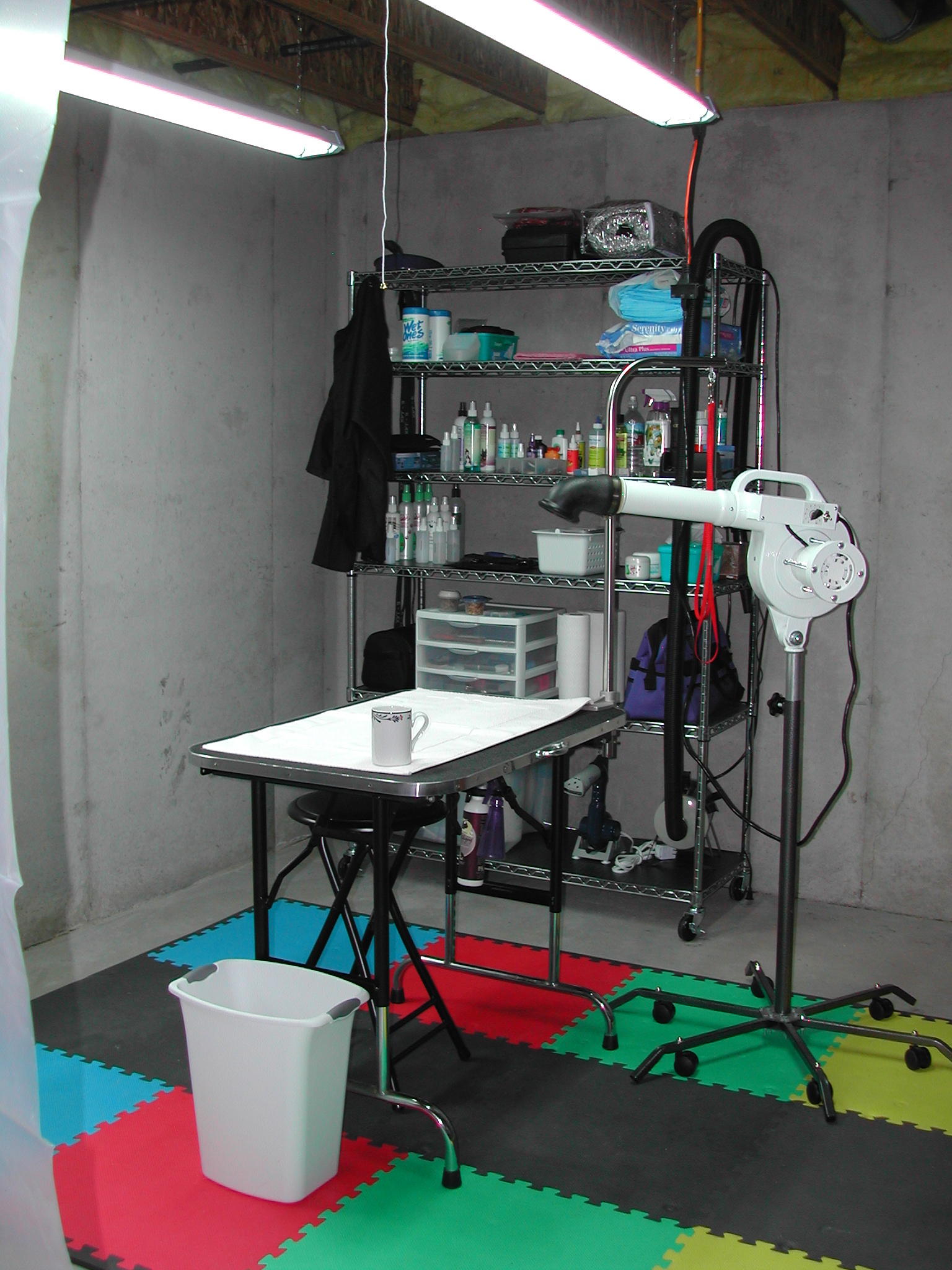
For those interested in doing their own grooming, I have two recommendations as a priority — a stand dryer and an adjustable grooming table.  For the dryer, I recommend an Edemco and you have two good choices from PetEdge: Search Results … the ED70016 for $429 or the ED3002 for $319.  Having a stand dryer will cut down on the amount of time needed to dry and you get to use two hands in the process.
 
Basement grooming area ... "DogRoom"
I prefer an adjustable 36×24 grooming table for home use.  Plenty of room and gives you the option of standing or sitting.  My choice (and this is about half of what I paid nine years ago for the same table) … PetEdge: Master Equipment Adjustable Height Grooming Tables.  Note the cushioned flooring in the main grooming area, purchased at Sam’s Club.
 
Clippers and how to use them … Andis or Oster are two good choices.  Because my basement is unfinished and without enough electrical outlets, I went with the Andis cordless model (which also means I’m not fighting a cord around a dog — a professional, we’re not!). 
 
This video is a good choice for getting started as it goes over bathing, clippers and techniques … “Grooming Your Dog – Basic Haircuts.”  One can also find grooming videos (Apso and Tzu) on YouTube with a quick search.  Just keep in mind that it’s only hair and it will grow back … one does get better with practice!
 
I have a grooming arm on the table (for the foster dogs’ safety) and recommend one from Table Works – Folding Grooming Arms (medium) as well as the tool caddy that fits the arm (use the side button link to see the caddy).  The tool caddy is unbelievably handy and I wish I’d gotten it sooner.  For those not wishing to purchase a stand dryer, the 24″ Table Works – Dryer Holder is a functional and well-built product.  Don’t waste your money on any other brand (been there/done that).  I can’t wait for the POS I currently have to give out so I can get one from Tableworks. 
 
Brushes.  I’ve used All Systems, Mandan, Christensen and MasonPearson.  I keep coming back to two … a Christensen pin brush and a bristle/nylon Mason Pearson.  Am currently using the 27 mm oval Fusion Pin Brushes.   It has brass pins and really does help cut down on the static generated.  Christensen has a #10 Buttercomb 7″ coarse rat-tailed comb which is good for faces and putting in a part down the back … Combs & Handles… as well as the #000 Buttercomb 7.5″ fine/course comb for overall use.  Christensen brush and comb “pins” are ground and polished which results in a smoother tip.  There really is a difference … Tip Test.   I do not use brushes with the little “balls” on the pin tips as this is hard on the coats (generally what one finds in the big box stores).
 
If you use a slicker brush (great for pulling out undercoat), Christensen has those as well … Slickers.  I have a Mark II that I use on the pet coats.  I found the All Systems Dematting Comb to be a good investment for my coats all around.
 
The Mason Pearson bristle/nylon brush I recommend is the brown Pocket size.  With two types of bristles, it gently teases out tangles without harming the coat.
 
If needing latex bands to keep hair up, I recommend these outlets … Lainee, Ltd. and Ena Lane.  I store my bands in their original bags in a ziplock bag in the freezer to keep the latex fresh.  No need in having a huge container of bands out.  The tiny imported compartment box from Lainee is quite handy for this …
 
Scissors.  Definitely get what you pay for here … invest a little more.  Suggest you go to a dog show and cruise the vendors, pick up and feel/fit the scissors to your hand.  I’d start out with a straight pair, probably 7-8 inches, and a curved pair.  Whatever you get, do not drop them as this can cause the blades to “nick” each other.  And then you have a blade that doesn’t cut smoothly, which means you’ll have to have them sharpened at the next show you go to.  I also like a small pair for trimming foot pads.
 
One doesn’t need to have a show dog to realize the benefit of having exercise pens, especially if doing a lot of traveling with dogs … J-B Deluxe Exercise Pen.  Also handy are Ground Covers.  Keeps the dog from getting soaking wet in the grass if it’s been raining.  The urine flows through it, keeping the dog clean.  Easy enough to clean up with a bucket of water, dries quickly and can be rolled up for storage/transport.
Camping with x-pens and ground covers
Camping with x-pens and ground covers -- front row, l-r, Dinky, Ali and Frankers; back row, l-r, Sierra & Emma

Crates:  I recommend a Mid-West 2-door crate in the 1624 DD model.  The double doors (DD) are great for vehicle or home use.  Also of benefit is a floor grate … Dog Crate Accessories – Midwest Divider Panels & Floor Grids for Dog Crates  (#1624 DD) … and recommended because the plastic pan will cause huge amounts of static if in contact with the dog’s coat.  Plus, if the dog has an accident or gets sick, the dog stays cleaner as any liquid falls through the grating.  And, yes, you’ll probably pay more for the floor grate than you will for the crate!

While this is pretty much falls under show equipment (used to get gear in/out of a show site), it is unbelievably handy around the house/yard as well.  I have this set up … MicroCart – ZZounds.com ($105 shipped … and you can read my review on the site).  This next site, however, shows how versatile the cart is … Micro Cart.  I had occasion to use it during an office move a couple years ago as well. 
 
If you have a male with housetraining issues, I recommend the adjustable Belly Bands from Small Dog Shop.  They are more form fitting and, thus, more comfortable for the dog.  Lined with a Depends or Serenity pad, they work great to contain male marking, keeping the boys and the furnishings clean.  And the adjustable type allows you to use it on similar-sized dogs.  In order to keep Dante clean on show weekends, he sports a belly band every trip outside.  This also means I don’t have to give him a belly bath every day before we go into the ring.  (Yeah, yeah, hubby says the dog folks are nuts …).
Dante in belly band
Dante in belly band, getting ready to go to the show ...
 
Below is a listing of fav sites for both show and pet items.  Note that some of the places have a “minimum order” charge so I usually get what I need from one place or make sure I have enough to get over the minimum or enough to get free shipping. 
 
 
Happy shopping!
 
Â